




Nature and environmental performance
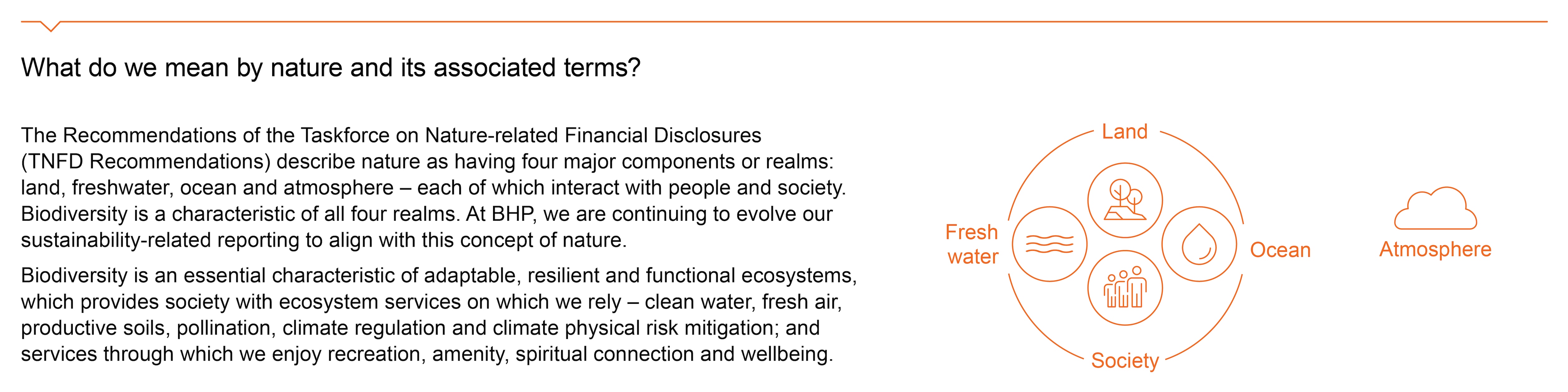
We recognise the interconnection between nature, climate and people and the risks posed by global nature loss. BHP, our suppliers and customers, Indigenous peoples and the communities where we operate, all depend on nature and the ecosystem services it provides. We understand our activities can impact nature.

Our ambition
Nature underpins the health of ecosystems and the services they provide, which are fundamental to the wellbeing of people, communities and the natural environment. Clean air, healthy ecosystems and reliable access to water support biodiversity, climate regulation, water availability and food production, all of which society, economies and businesses rely on. Access to safe, clean water is also widely recognised as essential to human health and the functioning of ecosystems.
Unmitigated climate change is expected to significantly impact the global natural environment and can influence or exacerbate existing risks, such as the loss of biodiversity. Nature is essential to climate regulation and offers important opportunities to manage and mitigate the impacts of climate change. The world’s management of climate-related risks and opportunities is therefore closely linked to effective stewardship of nature and vice versa. The reduction of global greenhouse gas (GHG) emissions required to meet the goals of the Paris Agreement is unlikely without halting and reversing nature loss and preserving and enhancing nature-based carbon sinks, such as those provided by forests, wetlands and oceans. At the same time, the potential impacts of climate change further threaten the environment, making natural systems less capable of withstanding and adapting to ongoing changes in the climate, and releasing further GHG emissions into the atmosphere when natural sinks are damaged or lost.
Increased demand for materials critical to supporting the energy transition and population growth has the potential to increase direct impacts on nature, including from land-use change, water use, pollution and introducing invasive species. Safe and reliable operations and supply chains to produce these materials depend on the services provided by healthy and functioning ecosystems (e.g. stable water supply and climate regulation).
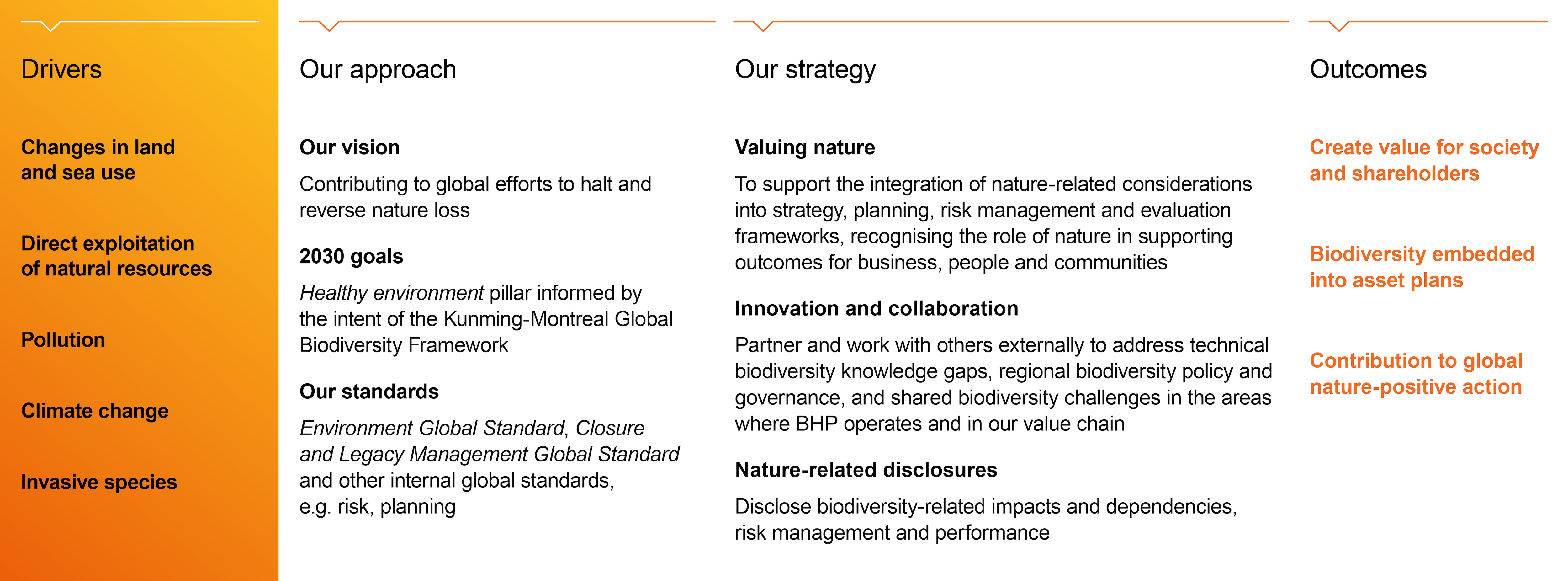
We acknowledge our mining operations across their lifecycle and the associated value chain can have direct and indirect impacts on nature, and our operations and supply chain are dependent on the services provided by healthy and functioning ecosystems. High standards of environmental stewardship therefore play an important role in supporting environmental protection, community confidence and the long-term resilience of our operations. Our vision is to contribute towards global efforts to halt and reverse nature loss and collective goals on nature and climate change to support business resilience and social value.1
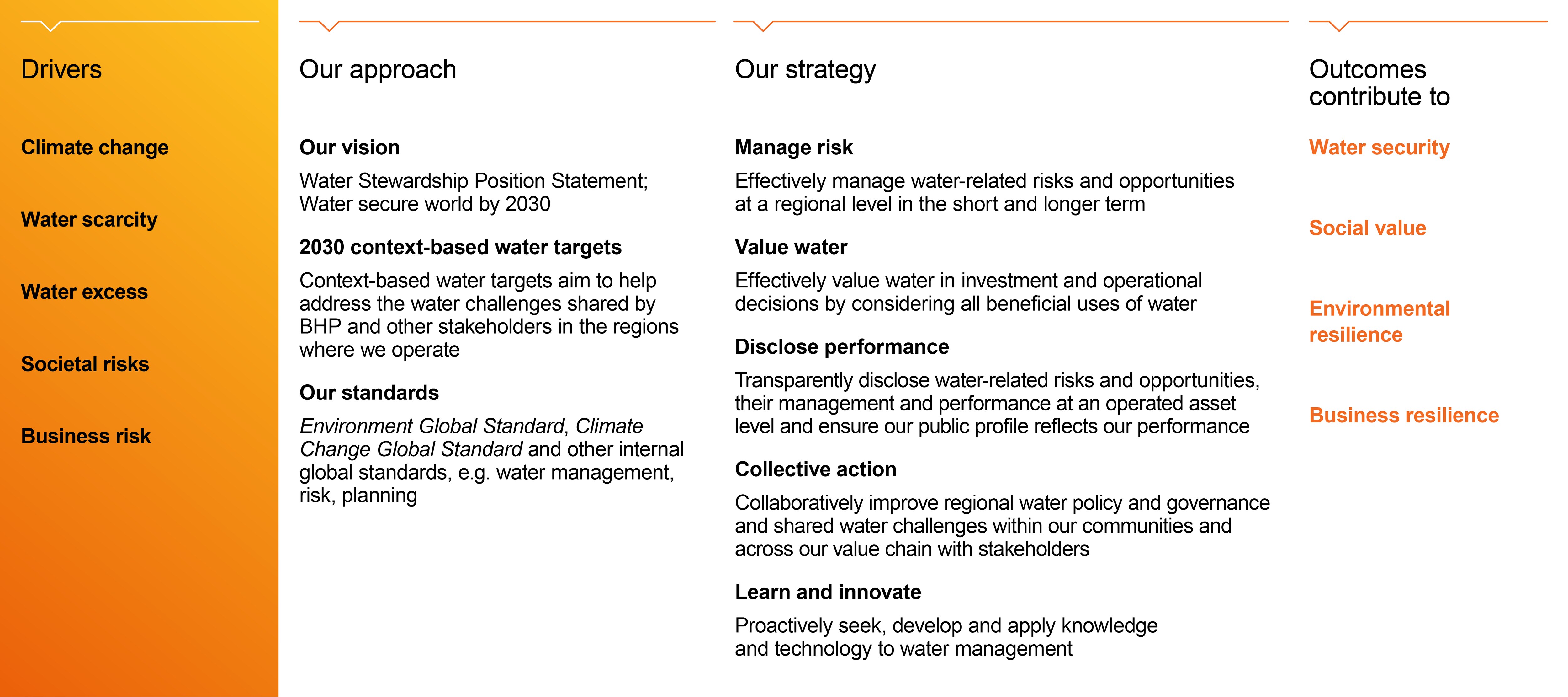
Our Water Stewardship Position Statement outlines BHP’s vision for a water secure world by 2030, which is aligned with the United Nations (UN) Sustainable Development Goals.
Our 2030 Healthy environment goal is to contribute to global nature-positive action by having at least 2 million hectares of land and water we steward2,3 under conservation, restoration or regenerative practices by FY2030. This is an area approximately equivalent to 30 per cent of the land and water we stewarded2 as at FY2023. In doing so, we will take into account areas of highest ecosystem value both within and outside our own operational footprint, in partnership with Indigenous peoples and local communities. We focus our activities in support of achieving this goal on the large areas of non-operational land we steward, as this land offers an opportunity for us to apply conservation, restoration or regenerative practices at a larger scale.
The key metrics to track progress on delivery of the 2030 Healthy environment goal are:
- Number of hectares (/ per cent4) area under stewardship that has a formal management plan that includes conservation, restoration or regenerative practices
- Number of our operated assets with a natural capital account5
We have evolved our water-specific public targets over more than 15 years – from intensity metrics (water used per tonne of product), to a combination of risk-based targets, absolute volume reduction targets and now regional context-based water targets.
Over the period of FY2018 to FY2022, we had a public water-related sustainability target to reduce FY2022 freshwater withdrawal6 by 15 per cent from adjusted FY2017 levels across our operated assets. We exceeded this with a 29 per cent reduction. During the FY2018 to FY2022 period, we also increased our use of non-freshwater sources in some of our regions.
We have continued to refine our approach to target and goal setting. Since FY2020, BHP has engaged third parties (such as universities) to undertake Water Resource Situational Analysis (WRSAs) to establish a collective view on the shared water challenges within the regions or catchments where we operate. We are now extending this approach to selected legacy assets, including Elliot Lake. These WRSAs have shown that while minimisation of freshwater withdrawal remains important, the most material water-related risks and challenges vary by region and, in some of the regions where we operate, freshwater withdrawal is not the primary water-related risk or challenge for the region.
In our Water Stewardship Position Statement, we commit to setting public, context-based water targets (CBWTs) to strengthen water management and support shared regional approaches. Informed by catchment risk assessments and WRSAs, we released our initial suite of asset-level CBWTs in FY2023, with targets and associated milestones in place through to FY2030.
More information on the WRSAs and CBWTs can be found at Shared water challenges.
Footnotes
1 Such as relevant United Nations Sustainable Development Goals and international agreements, such as the Kunming Montreal Global Biodiversity Framework.
2 It may include areas we stewarded for a period between FY2023 and FY2030 but have relinquished to a third party with the requisite expertise, and under conditions that create a high likelihood of durability of ongoing conservation, restoration or regenerative management practice.
3 Excluding areas held under greenfield exploration licences (or equivalent tenements), which are outside the area of influence of our existing mine operations.
4 The percentage metric measures progress towards having an area approximately equivalent to 30% of the land and water stewarded by BHP as at FY2023 (excluding areas held under greenfield exploration licences (or equivalent tenements), which are outside the area of influence of our existing mine operations) under conservation, restoration or regenerative practices by FY2030. For more information refer to the BHP ESG Standards and Databook 2026, Social Value Scorecard tab available at bhp.com/ESGSD2026. Natural capital accounts are a way to measure the amount, condition and value of environmental assets in a given area. They help describe changes in ecosystems and how these impact wellbeing and economies.
5 Withdrawal is defined as water withdrawn and intended for use (in accordance with the International Council on Mining and Metals (ICMM) guidance). Fresh water is defined as waters other than seawater, wastewater from third parties and hypersaline groundwater. Freshwater withdrawal also excludes entrained water that would not be available for other uses. These exclusions were made to align with the target’s intent to reduce the use of freshwater sources that are subject to competition from other users or the environment. The FY2017 baseline data was adjusted to account for the materiality of the worker strike affecting water withdrawals at Escondida in FY2017 and improvements to water balance methodologies at WAIO and BMA in FY2019, which included alignment of water balances to ICMM guidance. Discontinued operations (Onshore US-operated assets and Petroleum), BHP Mitsui Coal (BMC) and non-operated joint ventures were excluded.
Our approach and position
BHP’s biodiversity and water stewardship strategies provide a consistent framework to guide operational decision-making across the lifecycle of our operated assets. They reflect the interconnected nature of ecosystems and water resources and outline how we manage impacts, dependencies and shared challenges.
These strategies are underpinned by our policies and standards.
Our approach to biodiversity
Our approach to water stewardship

The BHP Board oversees our approach to sustainability and sustainability performance, while management is responsible for assessing and managing sustainability-related matters. The Board and its relevant Committees are informed on these matters, including nature and environmental performance-related topics, through Board papers, management updates, risk reports and presentations.
The Chief Executive Officer (CEO) is responsible for managing BHP’s activities, including nature and environmental performance, within delegated authority limits approved by the Board, and reports directly to the Board and Chair. The CEO is supported by the Executive Leadership Team (ELT).
The ELT monitors performance and progress on sustainability-related matters through regular updates from senior leaders, including presentations, papers and Board reporting. The CEO, ELT and management are responsible for assessing and managing sustainability-related matters, including implementing Board-approved strategy, policies and commitments, and performance against targets and goals, including the Healthy environment goal and context-based water targets.
Management, supported by asset and function teams, oversees and drives the implementation of sustainability-related strategies, including those relating to nature and environmental performance, climate change and Indigenous peoples.
For information on the role of the BHP Board in overseeing our approach to and delivery on sustainability, which includes nature and environmental performance, refer to the Sustainability approach webpage.
BHP engages across communities, government, business and civil society with the aim of encouraging actions to improve environmental outcomes while providing supporting economic growth, investment and job creation.
BHP undertakes regular stakeholder engagement activities, for example via process required by regulatory environmental impact assessments and as described on our Local Communities webpage. Examples of specific stakeholder engagement activities include:
- Various local stakeholders in our operating regions, including community groups, Indigenous groups, government (local and regional), industry members and representative bodies, and research institutes: For example, we undertake stakeholder engagement to develop the Water Resource Situational Analyses in our operating regions. We asked stakeholders what they value about water resources and their views of the challenges and collective action opportunities to preserve those values. Refer to Shared water challenges for more information.
- International Council on Mining and Metals (ICMM): BHP contributes to the ICMM through its Nature Working Group and its Closure and Water Peer Network. This connects member companies to share lessons and best practices.
- International Council on Mining and Metals (ICMM): BHP contributes to the ICMM through its Nature Working Group and its Closure and Water Peer Network. This connects member companies to share lessons and best practices.
- Minerals Council of Australia (MCA): BHP is an active member of the MCA’s Sustainability Committee. Through the MCA we contributed to the Australian Government’s environment protection law reforms.
- CEO Water Mandate: BHP is a signatory to the CEO Water Mandate and member and active contributor of the CEO Water Mandate’s Steering Committee.
- Proteus Partnership: BHP is a member of the Proteus Partnership, providing access to biodiversity spatial data, tools and scientific expertise, while enabling knowledge sharing and collaboration with member companies on biodiversity-related topics and emerging practices.
- Environment-related conferences: We continue to participate in and present at environment-related meetings and conferences, such as Water in Mining Global Summit and the AusIMM Life of Mine | Mine Waste and Tailings Conference, with the intent to share our experiences and learnings, and gain insight into current and future focus areas.
We work in partnership with others to contribute to a resilient environment beyond the areas under our stewardship, including the conservation, restoration and sustainable use of marine and terrestrial ecosystems. This includes collaborating with communities, research institutions and technical experts to strengthen the evidence base for decision‑making and support best practice environmental management.
Our partnerships and projects contribute to multiple, shared benefits, such as improving water quality or availability, advancing nature-based solutions to climate change, strengthening scientific capability and knowledge, and supporting local livelihoods and cultural values, alongside the core objective of conserving and restoring biodiversity.
Learn more about specific partnership examples in our case studies below.
Our Group-wide approach to environmental management is set out in the Environment Global Standard, which applies to BHP’s operated assets. The Standard defines mandatory minimum performance requirements, which include our environmental-related commitments, and describes how we manage environmental risks and opportunities through management systems aligned with ISO 14001.
The Environment Global Standard requires an integrated, risk-based approach to identifying, assessing and managing actual and potential impacts and dependencies across biodiversity, land, water and air, including direct, indirect and cumulative impacts. We establish monitoring, assurance and review practices to support ongoing management of environment-related risks and opportunities within our risk appetite, embedded through business planning, decision-making and project evaluation cycles. Together with our Climate Change Global Standard, this framework supports delivery of our goals, targets and commitments.
Additional Group-wide standards set mandatory minimum performance requirements for specific aspects of environmental management. These include the Closure and Legacy Management Global Standard and our internal water management standard, which outline operational and lifecycle requirements to manage environmental, including water-related, risks effectively.
The Community and Indigenous Peoples Global Standard requires each operated asset to respect human rights and Indigenous peoples’ rights, consistent with BHP’s Human Rights Policy Statement and Indigenous Peoples Policy Statement.
Our mandatory minimum performance requirements for risk management form part of BHP’s Risk Framework, which defines our approach to risk and opportunity identification, assessment, treatment, monitoring, review and communication, including requirements for the management of material risks.
We are also committed to alignment with the Global Industry Standard on Tailings Management, the global benchmark for social, environmental and technical outcomes related to tailings management, across all BHP operated tailings storage facilities. More information is available on our Tailings storage facilities webpage.
Risk management
BHP’s portfolio of long-life operated assets requires a long-term approach to managing nature-related risks and opportunities, including consideration of potential impacts and dependencies. We consider how changes in factors such as environmental conditions, land and water use, climate, population growth, regulatory requirements and societal expectations may affect the resilience of natural systems that support our operations and the communities where we operate.
Nature-related risks and opportunities are also considered across the full lifecycle of our assets, including closure and post-closure phases, where land use change, rehabilitation outcomes and long-term ecosystem condition may influence the ability of landscapes to sustain biodiversity, ecosystem services and related benefits to business and communities over time. More information is available on our Closure webpage.
Nature-related risks and dependencies can arise across landscapes, catchments and ecosystems, including freshwater systems, terrestrial habitats and areas of important biodiversity and ecosystems. These risks may affect operational continuity, future development options and access to nature’s benefits over the life of our assets.
In some locations, nature-related risks and opportunities may intersect with Indigenous peoples’ rights, cultural landscapes and ongoing connections to land and water, reinforcing the importance of respectful engagement, partnership and alignment with our commitments under the Community and Indigenous Peoples Global Standard.
Recognising that nature is shared, finite and interconnected, our approach to risk management extends beyond individual site boundaries. We consider interactions within broader landscapes and catchments (also referred to as basins on this webpage), including cumulative impacts and the condition of natural systems influenced by our operated assets alongside other land and resource users.
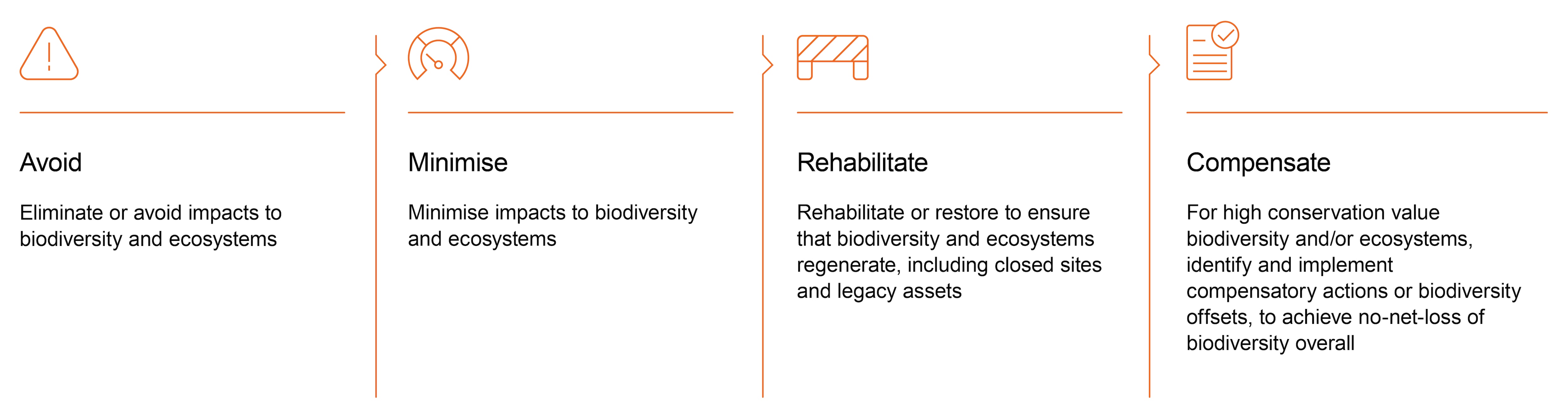
As detailed in the Environment Global Standard, our operated assets are required to understand their operational context by identifying and mapping key environmental features, including important biodiversity and ecosystems, water resources and catchments, and defining their area of influence. Assets are then required to identify and assess nature-related risks and put controls and plans in place in accordance with BHP’s Risk Framework and the Environment Global Standard. Our primary approach to treating nature-related risks is the application of the mitigation hierarchy, depicted below, supported by BHP’s frameworks, policies and processes, including governance, assurance and risk management. For more details refer to the BHP Annual Report 2026, Operating and Financial Review 6 – How we manage risk.
Nature-related impacts and dependencies may also give rise to transition risks, including changes in regulatory frameworks, evolving market expectations, permitting requirements and community or investor expectations linked to biodiversity protection, water stewardship and ecosystem health.
Nature-related risks are evaluated to identify material risks, which are considered in strategic and operational decision-making, including long-term planning, operational controls and investment decisions.
Water risk management
Water is an important part of BHP’s nature-related risk profile. Water-related impacts are assessed across two dimensions:- operational water-related risks arising from BHP activities
- basin-level (inherent) risks associated with the characteristics of the catchments where we operate, such as drought or flooding
This approach is consistent with International Council on Mining and Metals guidance and recognises the shared nature of water resources. We consider interactions within catchments (basins), shared marine regions and groundwater systems, including the activities of other water users.
Operated assets are required to identify, assess and manage water-related risks within their operating context, taking into account physical, hydrological, regulatory and socio-political conditions. Basin-level water risk is assessed using the World Wide Fund for Nature Water (WWF) Water Risk Filter, which evaluates physical, regulatory and reputational risks based on global and local datasets. The methodology allows asset- and region-specific local knowledge to be applied to verify and contextualise risk outcomes and is supported by other external frameworks, including the Chief Executive Officer Water Mandate. For more information refer to BHP ESG Standards and Databook 2026.
Impacts and dependencies
We have a range of potential direct, indirect or cumulative impacts on nature across the areas in which we operate, including land, freshwater, coastal and marine environments, and air. These impacts may contribute to broader drivers of nature loss, including land and sea use change, pollution and the introduction or spread of invasive species.
Potential impacts on nature may include:
- Removal of habitat – in preparation for resource extraction activities or infrastructure installation, which could completely remove a species or community if it is endangered or has a geographically restricted area of distribution.
- Changes to water availability or water quality – groundwater or marine water abstraction, re-injection of surplus water, surface water discharge or diversion, port facilities, disposal of dredge spoil or discharges into the marine environment could remove or alter habitat for a number of species or communities that rely on it for some or all of their life cycle.
- Use of infrastructure corridors – which may reduce a species’ ability to move or migrate, or increase the risk of death through vehicle or boat strikes.
- Introduction or spread of invasive species – competition, predation, infection arising from the introduction or increased spread of a non-native species may result in local extinctions of native species or reduced ecosystem function.
- Inappropriate disposal of waste – which could lead to death of animals, such as through entrapment, or illness due to consumption.
- Noise or light pollution – which could alter an animal’s behaviour (e.g. it may not be able to see or hear prey or predators, may avoid areas, or become disorientated).
- Reduction in air quality – increased dust or air pollution may alter vegetation structure or animal behaviour.
- Pastoralism – agricultural operations on non-operational land may impact vegetation structure, extent and condition, and impact soil quality, contributing to long-term land degradation.
In addition, we depend on the services provided by healthy and functioning ecosystems to support safe and reliable operations, including:
- Stable water supply – Water is integral to our business and vital to the longevity of BHP. We cannot operate without it.
- Climate regulation – Limiting the frequency and/or extremity of weather events, such as storms or flooding may damage critical infrastructure. For example, rail lines and ports are examples of a nature-related dependency that can have material effects on operations.
- Resistance to fire regimes – In some areas, such as in Australia, vegetation is adapted to some level of fire; however, increased frequency and intensity of fires can alter vegetation structure and may result in damage to key operational infrastructure.
- Social amenity – Regulation of air quality, noise and light levels by natural assets.
Our approach to managing these potential impacts is described in the Risk management, Policies and standards and Water risk management sections of this webpage, including our integrated, risk-based approach under the Environment Global Standard and BHP’s Risk Framework. For more information refer to the BHP Annual Report 2026, Operating and Financial Review 6 – Risk factors.
Performance and disclosures
We monitor and disclose our Group performance on a range of nature-related indicators and metrics in reference to external reporting frameworks, such as the Global Reporting Initiative (GRI) and the ICMM Performance Expectations. For more information refer to the Sustainability approach webpage and the BHP ESG Standards and Databook 2026.
For information on our environmental performance refer to the BHP Annual Report 2026, Operating and Financial Review 9.9 – Nature and environmental performance and the BHP ESG Standards and Databook 2026.
Case studies
- Enhancing species baselines using a novel monitoring technique
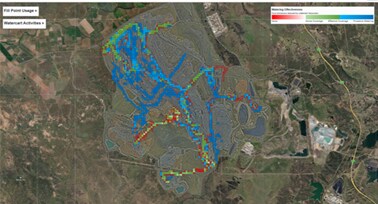
- Groundwater modelling decision support initiative
- River health partnerships in Queensland, Australia
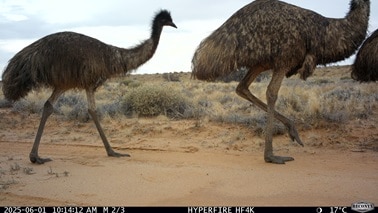
- Protecting Australia’s unique fauna
- Monitoring the threatened Pilbara olive python
- Pilbara water scheme success
- Supporting equitable access to water in the Fitzroy Basin
- Advancing the circular economy in Queensland’s resource sector
- Mapping of important biodiversity and ecosystems
- Pilbara Air Quality Program
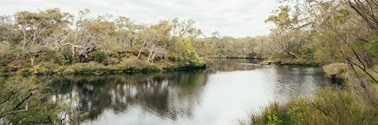
- Over 25 years of shared stewardship of Sheriff Creek Wildlife Sanctuary
- BHP case study a first for natural capital accounting in mining
- Application of the Seascape Framework to support conservation by Indigenous communities
- New use for wastewater in the desert
Sustainability case studies, organisational boundary, definitions and disclaimers, and downloads
-
BHP Annual Report 2026pdf

-
Sustainability reporting organisational boundary, definitions and disclaimerspdf
-
Límite organizativo de los informes de sostenibilidad, definiciones y descargos de responsabilidadpdf
-
BHP ESG Standards and Databook 2026xlsx
-
BHP Group Modern Slavery Statement 2026pdf
-
BHP Annual Report 2026, Sustainability Report 7.6 Methodology for calculating Scopes 1, 2 and 3 GHG emissions

-
BHP Climate Transition Action Plan 2024, subject to updates of certain aspects of our assumptions and plans in the BHP Annual Report 2025, Operating and Financial Review 9.8 – Climate changepdf
-
Global Industry Standard on Tailings Management – Public Disclosure 2026pdf
-
Tailings Storage Facility Policy Statement 2026pdf
-
Case studies